 |
NIGEL ROBERTS MMP, Mt McKinley, and me |
|
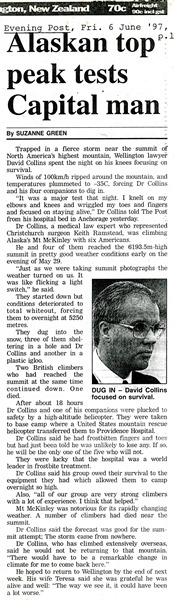
When New Zealand debated whether to adopt MMP, there were jokes about what the letters “MMP” meant. The correct meaning of the initialism is, of course, Mixed Member Proportional, but some claimed the letters stood for Many More Politicians, while others said the initials foresaw More Maori Parliamentarians. From my perspective, though, MMP also meant Mt McKinley’s Peak. As a political scientist, I’d had a high profile during the 1992 and 1993 referendum campaigns explaining how the Mixed Member Proportional voting system would work and then, as an election-night commentator for TVNZ, interpreting the results of the 1996 election (which was New Zealand’s first general election under proportional representation). These activities led directly to an expenses-paid invitation to attend an international electoral systems’ conference in Denmark. On my way home, I stopped off in London, where a climbing friend, Mike Sikora, asked me to join him on a June 1997 expedition to Mt McKinley. I had successfully summited Africa’s highest mountain, Mt Kilimanjaro, in 1985. Nine years later – in August 1994 – I climbed Elbrus. It’s in southern Russia, close to the Georgian border, and is the highest mountain in Europe. And on the last day of 1994 I’d stood proudly on top of Aconcagua. Its summit is 6962 metres above sea-level, and it is not only the highest mountain in South America, but it’s also the highest mountain in the world outside Asia. Having climbed three of the Seven Summits – the collective term for the highest mountain on each of the world’s seven continents – I was keen to tackle Mt McKinley, because – at 6190 metres – it is the highest mountain in North America. As a result, I jumped at the chance to do so. The mountain was initially named after William McKinley, President of the United States from 1897 till 1901 (when he became the third US president to be assassinated). However, the mountain was also widely known as Denali, especially by Alaskans, and in 2015 Barack Obama’s administration formally changed the peak’s name to Denali. MMP also helped me in a second crucial way. Because I had a leading role editing a book about the 1996 election, I’d been given a light lecturing load during the first half of 1997. My academic timetable was very flexible, and I was able to devote a lot of time to training for MMP – i.e., for Mt McKinley’s Peak. All was going well until the afternoon of June 6, 1997, when the front page of Wellington’s Evening Post had the headline, “Alaskan top peak tests Capital man”. The article beneath the headline described how Wellington lawyer, Dr David Collins, had been “trapped in a fierce storm near the summit” of Mt McKinley and had “spent the night on his knees focusing on survival.” Although Dr Collins “had frostbitten fingers and toes”, he was “the only one of the five” in his party unlikely to lose any.
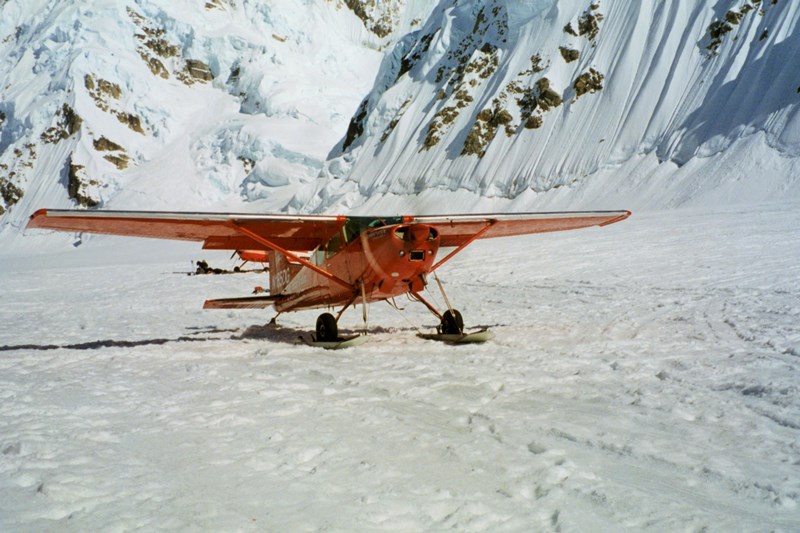
My first thought was to try to hide the paper from my wife, Heather. I couldn’t, and thankfully she reacted calmly to the story. I shouldn’t have been surprised. She’s very level-headed. Three years earlier, before I went to Russia, she memorably told me that she could live with the thought of my dying in a climbing accident, but that she’d be “bloody angry” if I was killed while flying on Aeroflot! Less than two weeks later, eleven of us – including Mike, who had flown in from London – assembled in Anchorage, the largest city in Alaska. We checked our gear, bought a few extra supplies, and on June 21 drove 185 kilometres north to Talkeetna, the frontier town at the foot of Mt McKinley / Denali. We went first to the Denali National Park’s ranger station where we registered our intentions to climb the mountain, and then to the airport. During the afternoon a small ski-equipped four-seater “bush plane” ferried us up to the spot at 2200 metres above sea-level on the Kahiltna glacier that serves as base camp for people climbing Mt McKinley via the mountain’s West Buttress route. It was mid-summer’s day and we were only a few degrees south of the Arctic Circle. As a result, it was light all the time.
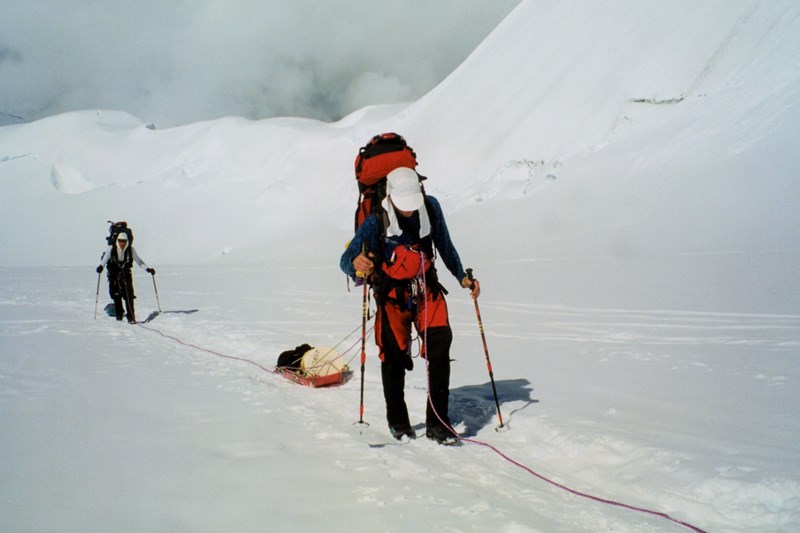
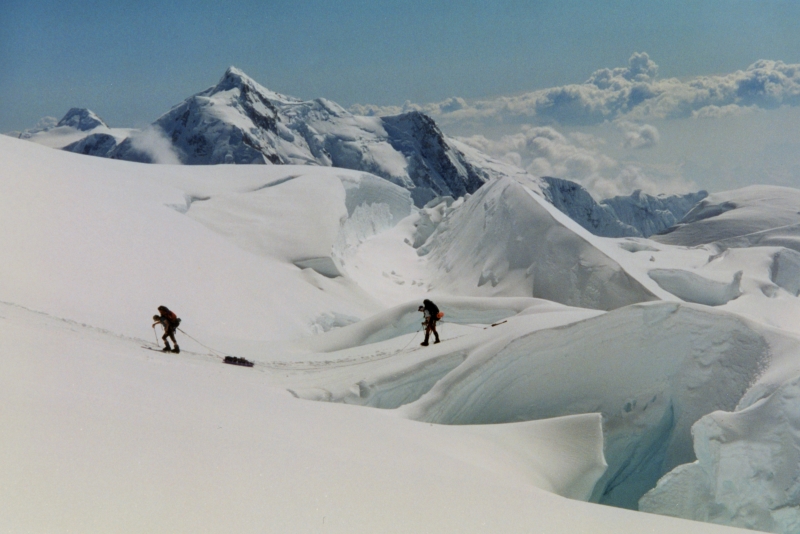
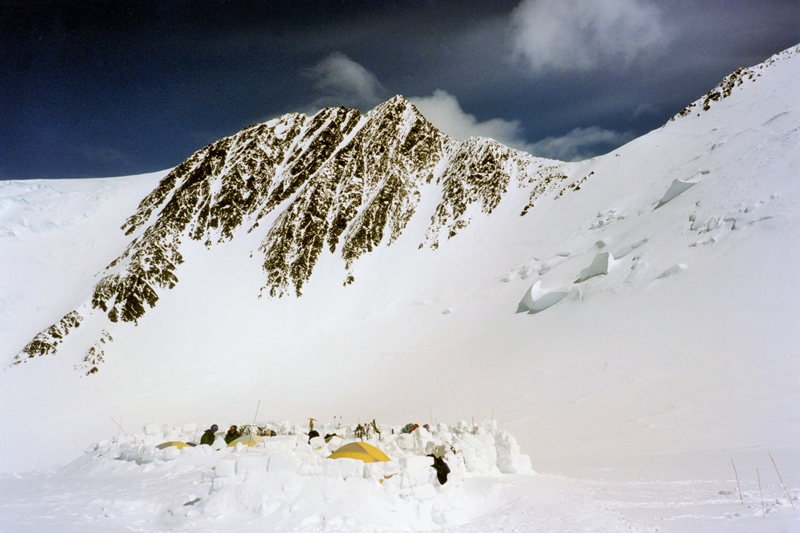
The temperature range, though, was startling. In the middle of the day in the full glare of the sun, it was sometimes warmer than 20 degrees C. In the evening, when the sun was just above or even below the horizon, and especially if the sun disappeared behind a mountain, the temperature could plunge to less than zero in a matter of minutes. The first part of our expedition – from June 21 to July 3 – went entirely according to plan. Blessed by excellent weather (which we’d later have cause to curse), we made perfect progress getting to our top camp (which was at 5200 metres above sea-level). Our normal pattern of activities during the first weeks of the climb was to spend one day hauling supplies (generally carrying gear in our rucksacks and, at the same time, pulling a small sled with more equipment on it) up to a cache-site, and then returning to our camp. The following day we’d break camp and – once again both carrying and pulling gear – either we’d move back up to our cache-site and camp there, or we’d go beyond our cache-site and the following day do a “back carry” to collect our cached supplies and take them up to our new camp site.
This system of double-carrying meant that on our way up Mt McKinley we climbed the section of the mountain from 2200 metres to 4900 metres twice. It was arduous, but it was doubly beneficial. Our fitness levels improved, and we were also obeying crucial advice for high altitude climbers: climb high, sleep low.
If all had gone to plan, we would have made our summit bid on Friday, July 4 – a highly appropriate date given that we were tackling the highest mountain in the United States. However, high winds on July 4 and snow and a white-out on July 5 precluded summit attempts on either day. Sunday morning, July 6, was bright, clear, and still. Because it was light all day, we didn’t hurry. We prepared carefully and slowly for the final portion of the climb, and only left our top camp (which was at 5250 metres) at 9:50 am. We took more than three hours to climb Denali Pass, then another four hours getting up to and across the Football Field (a small plateau about 250 vertical metres below the summit).
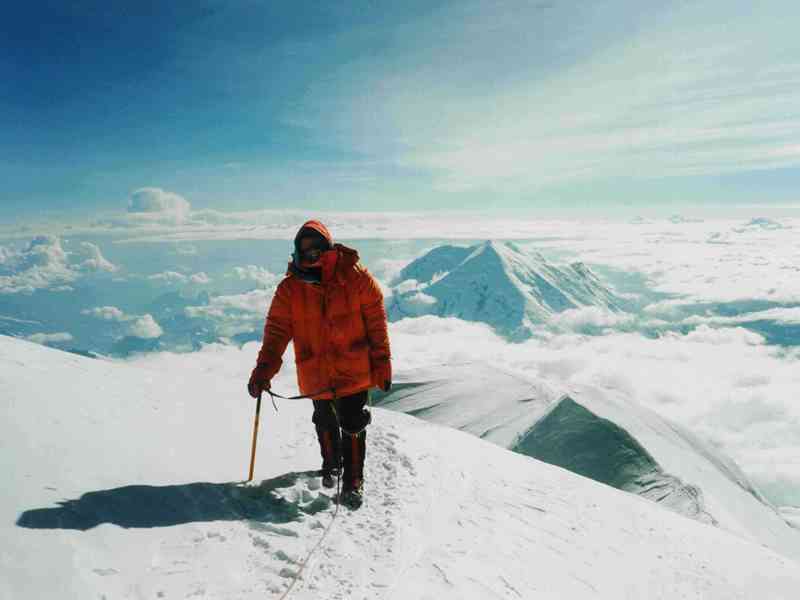
The final part of the climb, the summit ridge, was the most exposed of the entire trip. On our right, there was a 3000-metre drop below us!
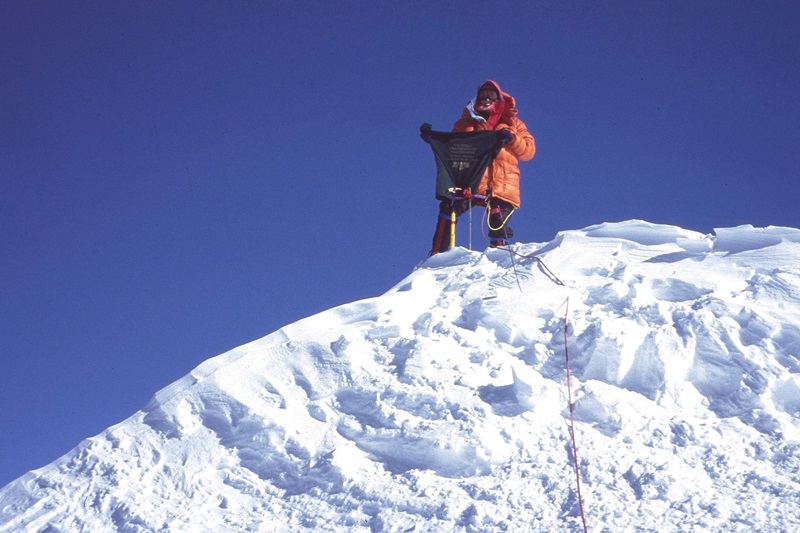
However, my head for heights was pretty good, and at 7:03 pm the three-person rope team I was on reached the summit. We stayed there for about 15 minutes. I didn’t have a flag with me, so was photographed instead holding up a Victoria University of Wellington t-shirt.
Nine of us reached the summit (our leader – and chief guide – Sean summited for the tenth time). Having spent 16 days reaching the summit of Mt McKinley, we hoped to follow normal practice and descend in just two. We got back to our top camp at 12:45 am on July 7 and left it exactly 12 hours later. Despite being dog-tired, we headed down relentlessly, pausing only for 75 minutes’ sleep. However, at 8:00 am on July 8 our route down the Kahiltna glacier was barred by massive crevasses. The good weather that had aided our ascent now had negative repercussions for us. Not only had snow bridges collapsed, but the warm weather also meant planes couldn’t land either at base camp or where we were stuck at 2250 metres above sea-level. After three days we moved further up the mountain again, hoping there’d be a freeze at 2700 metres.
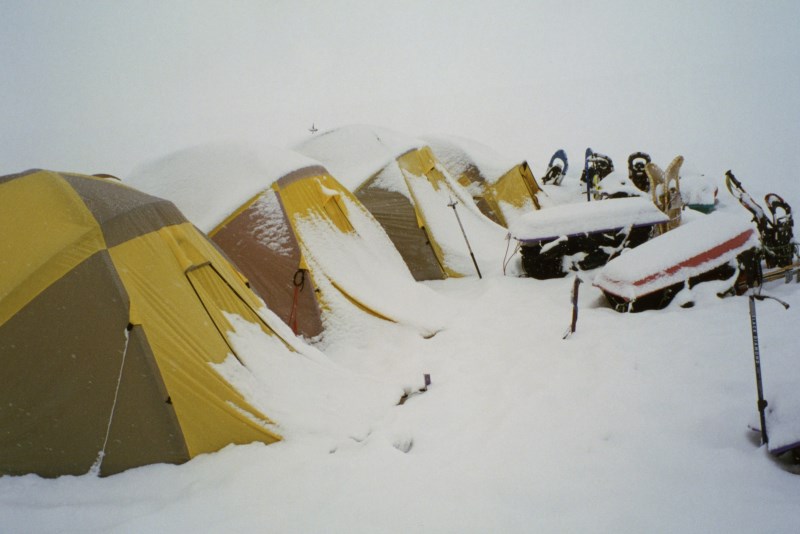
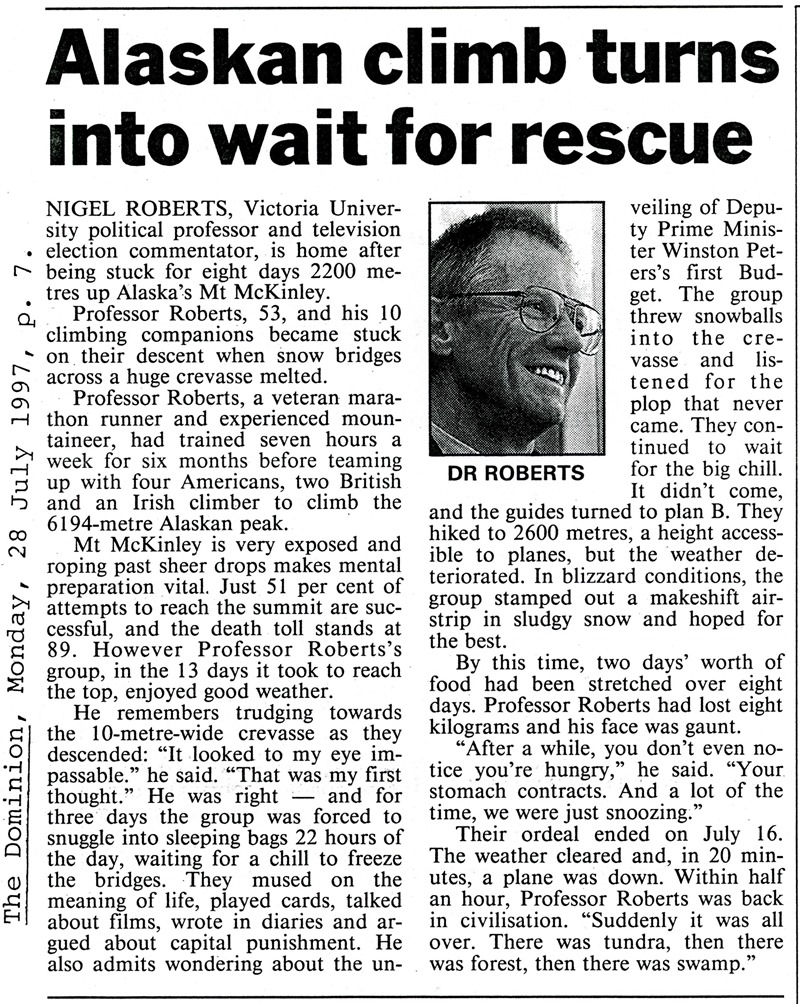
No such luck: the weather deteriorated, so – after another four days of almost constant light snow with visibility down to about 50 metres – we retreated further up the mountain to the three-thousand metre mark. That proved to be the right thing. At 8:00 am on July 16 – eight days after we had thought we’d get off Mt McKinley – the clouds lifted and at 9:30 am I was on the first plane off the mountain. Thirty-three minutes later, I was back in Talkeetna and able, for the first time, to let Heather and our son, as well as work colleagues, know where I was and what had happened to me. In accordance with its disgraceful policy guidelines, the US national park service had refused to pass on any messages about anyone who was stuck on Mt McKinley. Understandably, my elderly parents (both in their mid-80s) and my son (in his early 20s) were worried sick about my unexpected and unexplained absence. Once again, though, Heather’s level-headedness had prevailed. She refused to worry about me and had wisely focused, instead, on her mother’s bout of ill-health. I eventually got back to Wellington a week after the start of the university’s second trimester. When one of my students heard what had happened to me, she contacted a reporter who worked on The Dominion. As a result, as had been the case with David Collins, my Mt McKinley experiences were also the subject of a newspaper article. “Alaskan climb turns into wait for rescue” was the headline (which was deservedly far less dramatic than “Alaskan top peak tests Capital man”).
Justifiably, too, the story was not front-page news. It was rightly relegated to page seven. It was, though, a travel adventure I’ll never forget, because I now know that the initials “MMP” also stand for McKinley’s Multifarious Perils. * * * * * * * * * * * * * * * * * * * * * * * * * * * * * * Nigel Roberts is an emeritus professor of political science at Te Herenga Waka / the Victoria University of Wellington. Detailed illustrated accounts of his travels can be found on his website (www.nigel-roberts.info). * * * * * This article was published in The Post, Wellington's daily paper, as well as in other newspapers in the Stuff stable, on Monday, November 18, 2024. (The headline The Post gave the article was "Mt McKinley and me".) * * * * * |
||