 |
NIGEL ROBERTS The Portuguese Coastal and Central Caminos |
|
In the Middle Ages, people from all over Europe went on pilgrimages to the tomb of St James (i.e., Sant Iago) in north-western Spain. As a result, there are many different Caminos de Santiago. The best-known is the Camino Francés – the French way – which goes through Pamplona, Burgos, Léon, and Ponferrada in northern Spain. Walking the Camino Francés is extremely popular: about a quarter of a million people did so last year. It’s nearly 800 kilometres long. Thus, to walk the whole route averaging half-a-marathon per day takes roughly 38 days. That’s considerably more time than many people can take off work or be away from families and friends. However, that’s where the other Caminos de Santiago can come into play. Knowing that my wife, Heather, and I had thoroughly enjoyed the 27 days we’d spent walking two-thirds of the Camino Francés in 2010, friends in Wellington recommended the Portuguese Camino routes to us. “We’re sure you’ll like them too,” they told us. We put the idea to California friends, Bob and Peggy, who’d walked the final 134 kilometres of the Camino Francés with us. They quickly agreed, and – as a result – the four of us arrived in Porto, the second largest city in Portugal, in late September 2017, almost seven years after our Camino Francés experiences. Porto is stunningly beautiful.
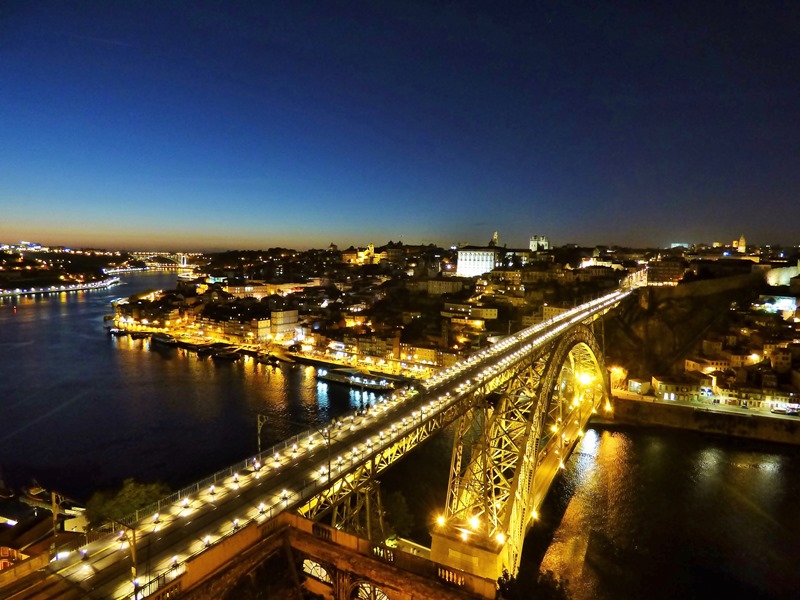
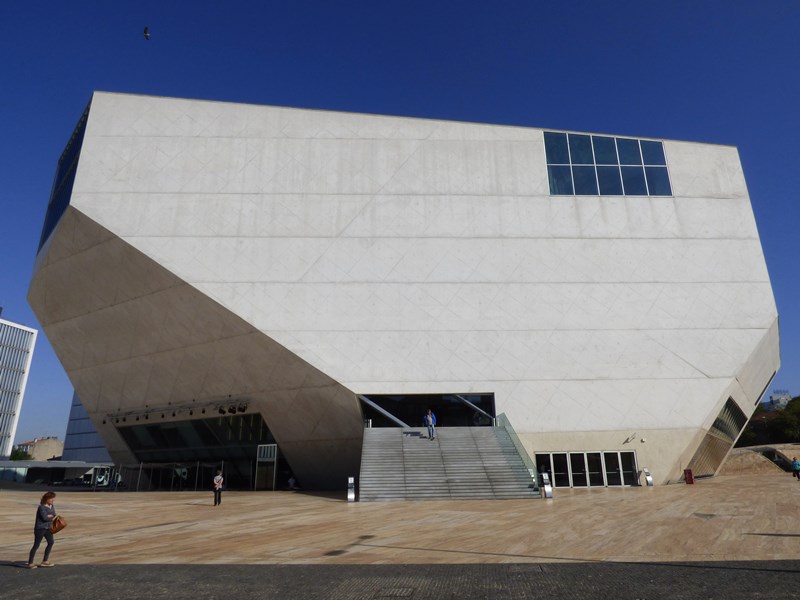
Situated on the banks of the River Douro, close to the Atlantic coast, it’s home to more than ten major wine cellars specialising in fortified wines called vinho do Porto (namely, wine of Porto), but which we refer to in English simply as port. Another local product well worth sampling is vinho verde, which literally translates as green wine but is in fact a very tasty young white wine. The historic centre of Porto is a UNESCO World Heritage Site. Three of its most striking buildings are the dual road and rail bridge across the Douro, the railway station, and the city’s modern concert hall. They were built in the 19th, the 20th, and the 21st centuries respectively. The Dom Luis I bridge is an imposing double-deck metal arch bridge that was designed by Theophile Seyrig, a student of Gustave Eiffel, and built in the 1880s. It is especially striking when floodlit at night. The São Bento railway station was completed in 1903. It’s a beaux arts building – right in the centre of the city – that has been described as “one of the world’s most beautiful train stations”. It is beautiful both outside and inside, because its interior walls are covered with azulejos, the attractive blue tiles for which Portugal is justly famous. Porto’s concert hall – its Casa da Música (House of Music) – was designed by the renowned Dutch architect, Rem Koolhaas, and opened in 2005. It’s a nine storey “asymmetrical polyhedron” – in other words, it looks somewhat like a tipsy Rubik’s cube. One architecture critic has compared its “exuberant design” to Frank Gehry’s Guggenheim in Bilbao.
After several days’ sightseeing in Porto, Bob, Peggy, Heather, and I started walking. There are two Camino routes linking Porto and Santiago de Compostela. The main route is the Portuguese Central Camino, which is an inland route that heads due north from Porto. Not quite as popular (but rapidly catching up) is the Portuguese Coastal Camino. As its name suggests, it hugs the Atlantic coast for two-thirds of its way to Santiago, before linking up with the Central Camino in Redondela, near the head of the Vigo estuary (which is the southern-most of four large estuaries on the Atlantic coast of north-west Spain).
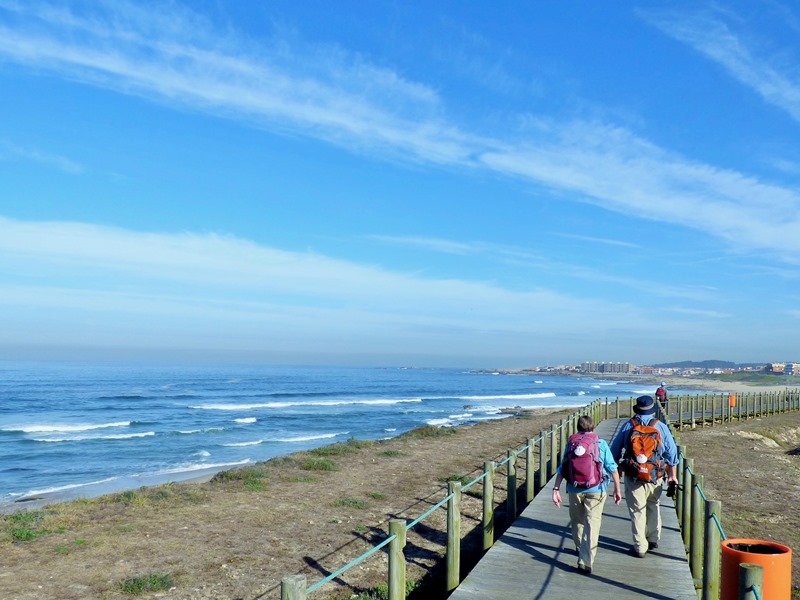
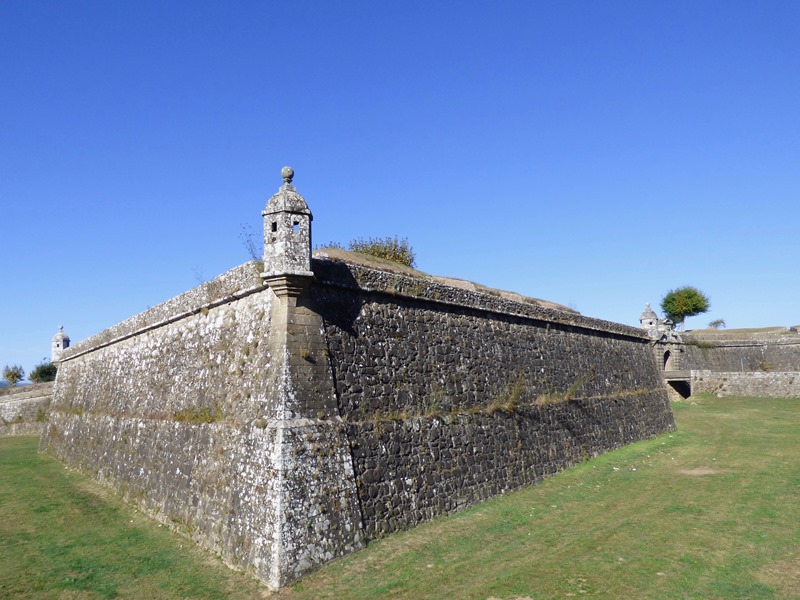
Our Wellington friends who’d told us about the Portuguese Caminos also recommended a small Portuguese company that could organise our itinerary, accommodation, and luggage transfers. We duly took their advice and were very pleased we did. The company created an itinerary especially for us. We began our 13-day hike on the Coastal Camino, but on Day 2 headed inland to Arcos, where we joined the Central Camino and then followed it for the next 11 days. Our accommodation – in a variety of small hotels and bed-and-breakfast establishments – was arranged and paid for in advance, and while we walked carrying only daypacks, our heavy luggage was efficiently moved by specialist transfer companies from destination to destination. It was, frankly, the ideal way for four senior citizens in their seventies to do a long-distance hike. We walked a total of 244 kilometres (averaging slightly less than 19 kilometres a day). For the first seven days we were in Portugal, where highlights included heading north along the Coastal Camino with the Atlantic Ocean’s breakers hitting the beaches and rocks to our left; spending an afternoon and evening in Ponte de Lima – a beautiful small town on the banks of the Lima River; and exploring the massive fortifications in Valença on the country’s border with Spain. The city’s bulwarks and moats played a decisive role defending Portugal during attacks by Spain.
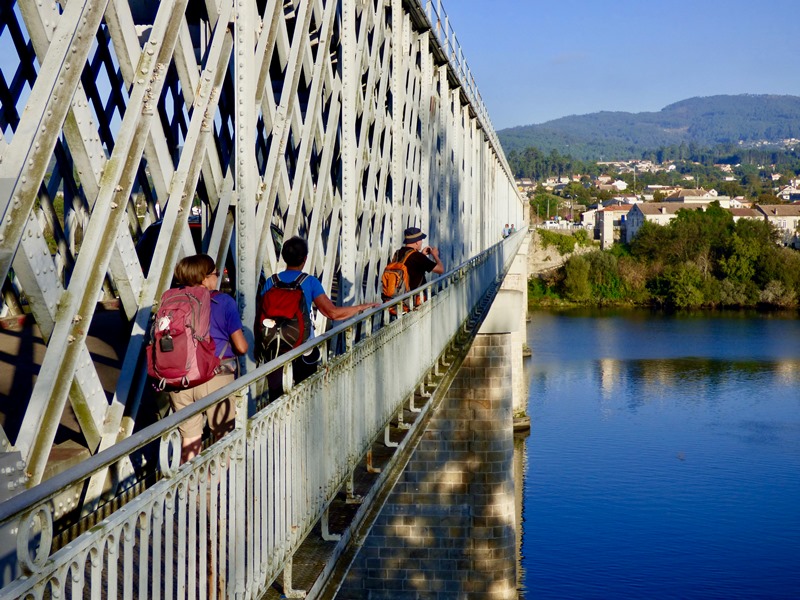
On the eighth day of our hike, we left Valença and crossed the Minho River on a large iron bridge that links Portugal and Spain. Camino waymarkers in Spain are astonishingly precise. We’d only been in Spain for a few minutes when we encountered one that told us we still had 115.454 kilometres to go to reach the cathedral in Santiago!
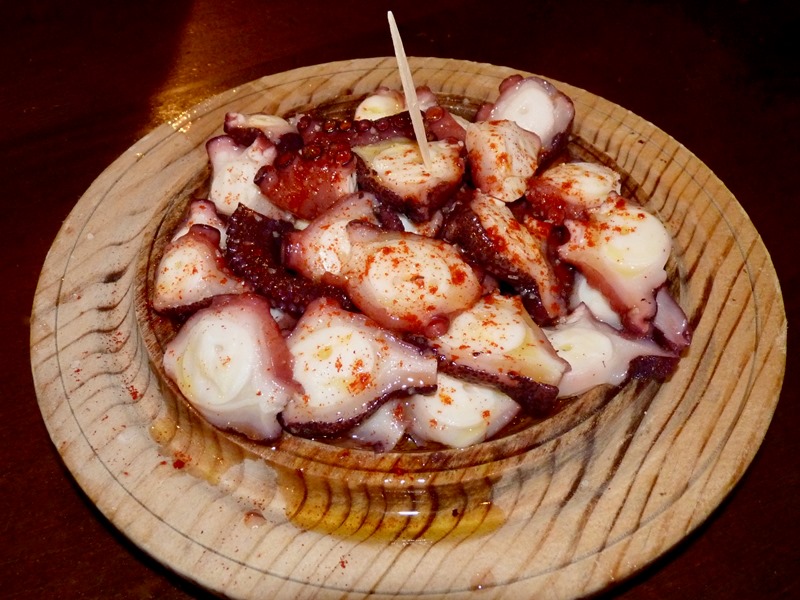
We were now in Galicia, one of the country’s 17 autonomous communities, and on our first night there I enjoyed one of my favourite culinary treats: pulpo – i.e., octopus. I’d initially encountered the dish seven years earlier. It’s a speciality of the region, and I rapidly became addicted to it.
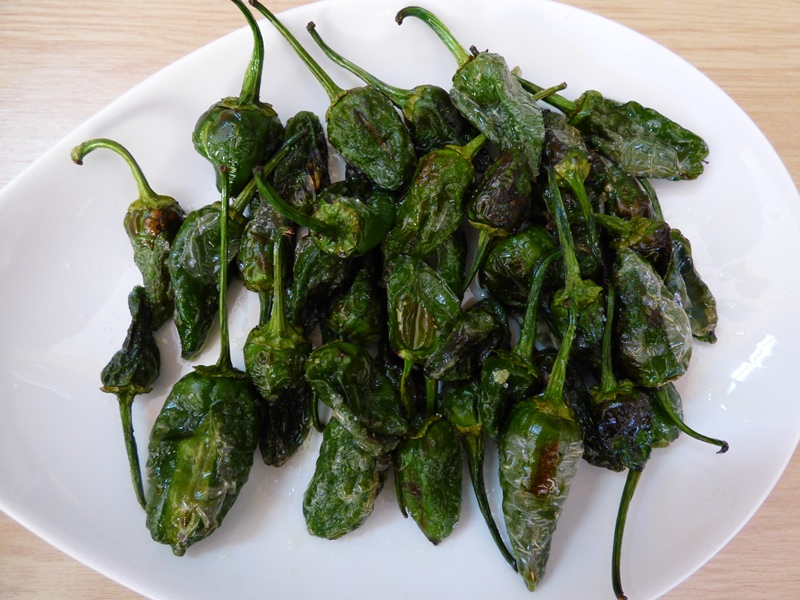
Then, on the penultimate day of our walk, I discovered another Galician delicacy: pimientos, sometimes called the peppers of Padrón. I’d never thought of myself in such terms, but Spain (and/or walking long distances in relentlessly hot sunshine) certainly unearthed the hidden foodie in me.
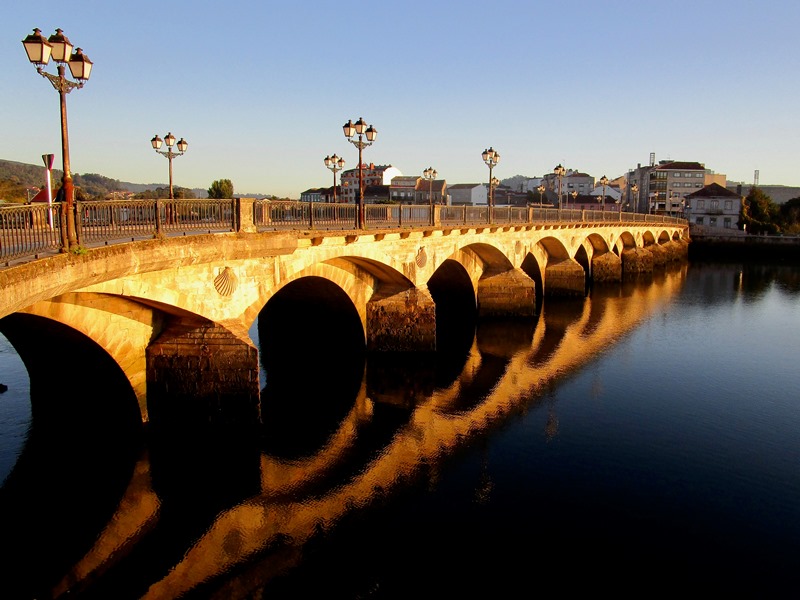
Three days after we left Portugal, we arrived in Pontevedra, a small city that has “one of the best-preserved historic town centres” in Spain. One lovely little building was the 230-year-old Church of the Virgin Pilgrim. Its ground floor plan is shaped like a scallop shell, the symbol of pilgrims making their way to Santiago. Pontevedra gets its name from the Latin for “old bridge”, and – for me – one of the highlights of the whole walk was seeing the city’s old 12th century bridge, the Burgo bridge, shortly after sunrise at the start of our eleventh day on the Camino. It was simply stunning.
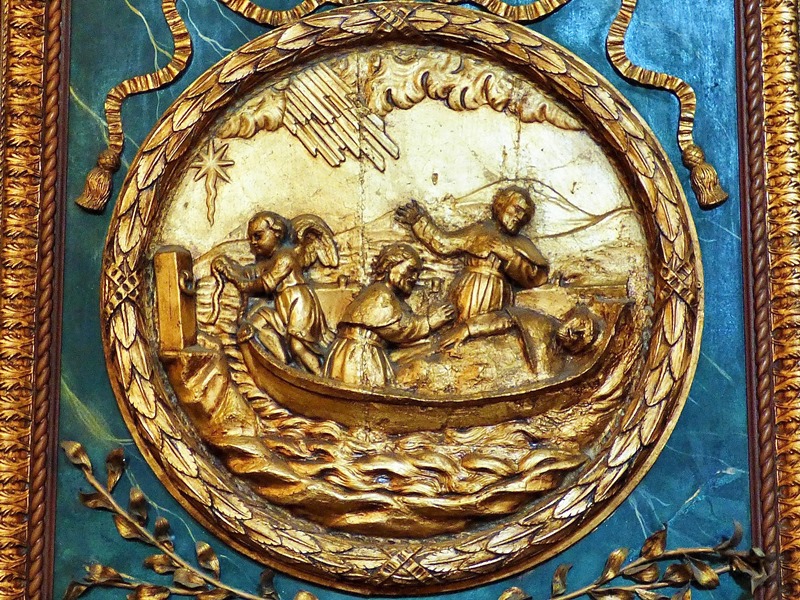
Two days later, we reached Padrón, where – according to local legend – the boat bearing the body of St James was moored prior to his burial in Santiago. As a result, we visited the Igrexa de Santiago (the Church of St James), where there’s a wonderful plaque depicting the scene. It was a visual reminder of why, still today, every year hundreds of thousands of pilgrims make their way to Santiago.
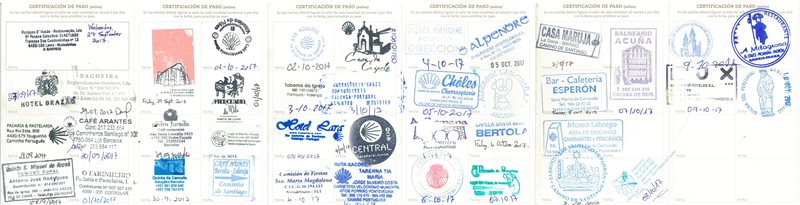
Our 13-day hike ended the next afternoon when – for the second time in seven years – Bob, Peggy, Heather, and I arrived at and were photographed in front of the cathedral in Santiago de Compostela. The following morning we went to the Pilgrim’s Reception Office to get a final stamp in our “pilgrim’s passports”, proving we’d walked the requisite distance in order to qualify for our compostelas, which have been described as “a sort of certificate of completion offered by the cathedral authorities in Santiago.”
Our holiday was over. In the space of a mere fortnight, we’d had a full Camino experience in two countries: testing and sometimes tiring but always manageable hiking; amazing sights and scenery; cultural, historical, and spiritual encounters; convivial companionship; and, oh, did I mention the food? As a result, I can only echo our Wellington friends who recommended the Portuguese Caminos to us. I am sure you’ll like them too. * * * * * * * * * * * * * * * * * * * * * * * * * * * * * * Nigel Roberts is an emeritus professor of political science at Te Herenga Waka / the Victoria University of Wellington. Detailed illustrated accounts of his travels can be found on his website (www.nigel-roberts.info). * * * * * This article was published in The Post, Wellington's daily paper, as well as in other newspapers in the Stuff stable, on Monday, April 28, 2025. (The headline The Post gave the article was "The Caminos: A Tale of Two Walks".) * * * * * |
||